
Google just quietly dropped one of the most important AI research papers of 2026 — and most people scrolled right past it. No flashy demo, no viral video. Just a research paper called TurboQuant, headed to ICLR 2026, that could fundamentally change how we build and deploy AI-powered software.
At SudamHub, we build web apps, SaaS products, and AI-integrated solutions for clients in Nepal and worldwide. So when something like TurboQuant lands, we pay attention — because it directly affects what we can build, how much it costs, and what's now possible.
Let's break it down in plain language.
First, What Problem Does TurboQuant Actually Solve?
When an AI model like ChatGPT or Gemini processes a conversation, it needs to remember everything that came before in that conversation. It stores this "working memory" in something called a KV cache (Key-Value cache).
Here's the problem: the KV cache is huge. For a typical 8 billion parameter model running at 32,000 tokens of context, the KV cache alone can eat up around 4.6 GB of GPU memory — and that's just for one user. Scale that to multiple users, longer conversations, or bigger models, and you hit a wall fast.
This memory bottleneck is exactly why running AI in the cloud is expensive, why on-device AI on your phone is limited, and why many long-context AI features (like analyzing an entire codebase or a 100-page document) cost so much.
TurboQuant is Google's answer to that wall.
So What Does TurboQuant Actually Do?
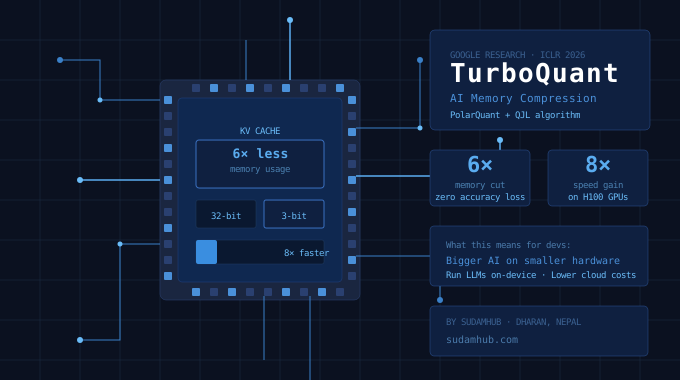
In simple terms, TurboQuant compresses the KV cache from 16-bit numbers down to just 3 bits — with zero accuracy loss. That's roughly a 6× reduction in memory, plus up to 8× faster inference on NVIDIA H100 GPUs.
To understand why that's remarkable, think of it like this: imagine you have a detailed handwritten notebook. Traditional compression is like photographing every page at lower resolution — you save space, but lose clarity. TurboQuant is more like inventing a perfect shorthand that captures every idea with a fraction of the ink, and you can still read it back perfectly.
It does this through a two-stage mathematical process:
Stage 1 — PolarQuant: The algorithm rotates the data vectors into a new coordinate system (polar coordinates) where their distribution becomes uniform and predictable. Because the shape of the data is now known in advance, the system no longer needs to store expensive decoding constants alongside the compressed data — eliminating the "memory overhead" that defeats most other compression methods.
Stage 2 — QJL (Quantized Johnson-Lindenstrauss): Even after PolarQuant, tiny errors remain. QJL uses a 1-bit correction to statistically cancel those errors out, keeping the attention mechanism accurate across long conversations.
The result: TurboQuant is training-free, model-agnostic, and can be dropped into any existing transformer model — Gemma, Mistral, Llama — without retraining or fine-tuning.
Why This Is Big News for Developers
Here's what actually changes for people building software:
1. Longer context on existing hardware If you're building an AI feature that needs to analyze a large document, a long chat history, or an entire codebase, context length has always been your enemy. TurboQuant means you can push that boundary significantly without buying more expensive hardware.
2. AI on smaller, cheaper devices This is the one that excites us most. On-device AI has always been bottlenecked by memory. A Mac Mini with 16GB of RAM, a mid-range phone, a Raspberry Pi-class edge device — TurboQuant moves the goalposts on all of these. Sophisticated AI features that previously required cloud API calls could soon run privately, locally, and cheaply.
3. Lower API and cloud costs When model providers can fit more requests on the same hardware, they pass those savings on through pricing. We've already seen AI API costs drop dramatically over the past two years. TurboQuant-class optimizations are a big part of what keeps that trend going — which means the AI features you integrate into your products get cheaper to run over time.
4. It works right now, with existing models Unlike most AI breakthroughs that require months of training runs and new model releases, TurboQuant is post-training — you apply it to a model that already exists. Community implementations in PyTorch, MLX (for Apple Silicon), and llama.cpp already exist and are showing real results that match the paper's claims.
What About the Bigger Picture?
TurboQuant landed with enough force to shake global stock markets. Samsung, SK Hynix, and Micron — the world's biggest memory chip makers — saw their share prices drop sharply the day the paper went public. Investors feared that if AI suddenly needs 6× less physical memory, demand for expensive RAM chips would slow down.
That reaction tells you something important: TurboQuant isn't just a neat research trick. It's the kind of efficiency breakthrough that changes the economics of an entire industry.
Some analysts have called it "Google's DeepSeek moment" — a reference to how DeepSeek shook the AI world earlier this year by achieving top-tier performance with far fewer resources. The pattern is the same: brute-force hardware scaling gives way to algorithmic elegance.
What This Means for Us at SudamHub
At SudamHub, we are always thinking about how to build better, faster, and more cost-effective software for our clients. TurboQuant is a clear signal of where the AI landscape is heading in 2026:
AI is no longer just for big budgets. Smaller teams and startups in Nepal and across South Asia can build AI-powered products without massive cloud bills.
On-device and edge AI is becoming realistic. Apps that need to work offline, handle sensitive data privately, or run on affordable hardware just got much closer to being viable.
The tools we use are getting smarter underneath. Whether it's a chatbot, a document analyzer, a recommendation engine, or a code assistant — the infrastructure layer is rapidly becoming more efficient and accessible.
We are watching community implementations of TurboQuant closely as they mature into production-ready tools. The algorithm is already being integrated into llama.cpp (the most widely used local LLM runtime), which means the benefits will flow into the developer ecosystem quickly.
TL;DR
Google's TurboQuant compresses AI working memory by 6× with zero accuracy loss, makes inference 8× faster on modern GPUs, requires no retraining, and works on virtually any existing AI model. It is the most significant AI efficiency breakthrough of early 2026, and it matters for anyone building, deploying, or planning to integrate AI into their software.
The next era of AI won't just be bigger models — it will be smarter infrastructure. TurboQuant is a clear step in that direction.